The Basics
If you’re like me, you may have
heard of the school-to-prison pipeline but no one ever really explained what
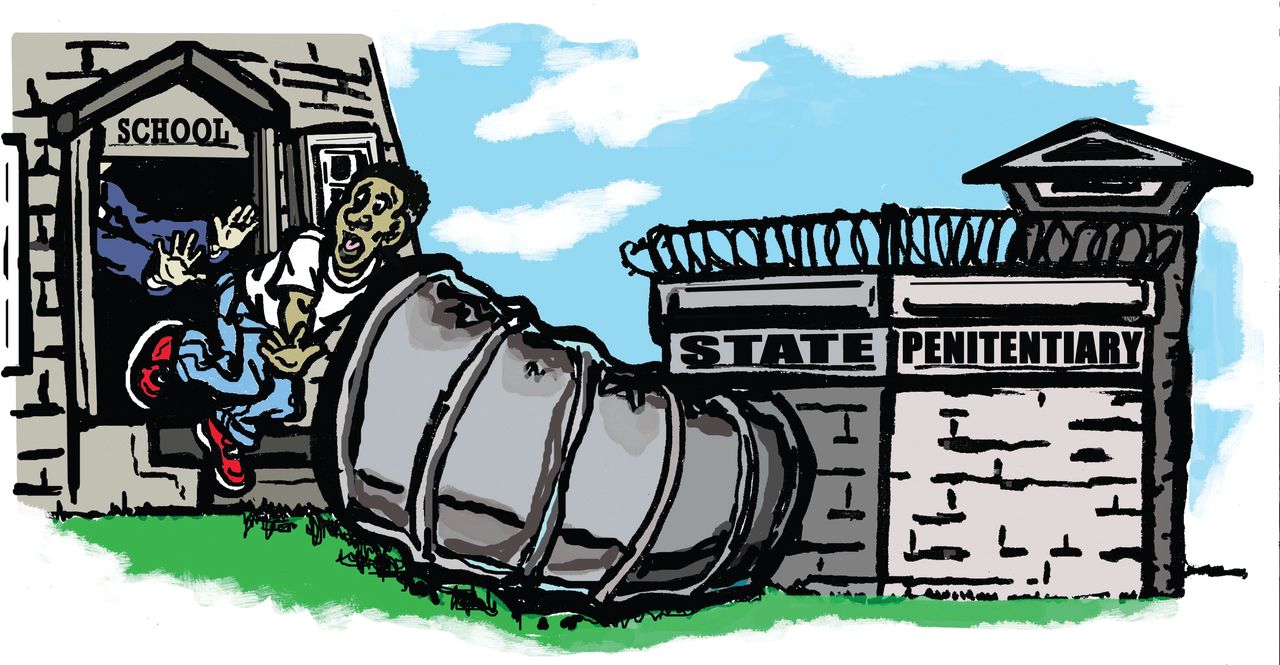
exactly it really means. The ACLU (2018) describes it as, “a disturbing
national trend wherein children are funneled out of public schools and into the
juvenile and criminal justice systems”.
This is the basic explanation but there is so much more to it than that.
Some of the biggest contributors in the school-to-prison pipeline are
unproductive learning environments and lack of school resources, the
implementation of the zero tolerance policy, and the use of police in the
classroom.
The school-to-prison pipeline
usually begins with issues in school resources. These issues usually consist of
“[o]vercrowded classrooms, a lack of qualified teachers, and insufficient
funding for "extras" such as counselors, special education services,
and even textbooks, lock students into second-rate educational environments”
(ACLU, 2018). When students are subjected to problematic learning environments
they are much more likely to become problematic students. It is extremely
unrealistic of us to throw students into unproductive and inadequate learning
environments and expect them to flourish and thrive. These students are
products of the environments the school system has created and they are doing
nothing more than modeling the behavior that is expected of them in such
environments. We can not expect students to do well in school and in life as a
whole if they are treated as nothing more than a number which is typically what
happens in the situations where overcrowded schools are the issue. In these
situations, students do not get the attention and assistance that is required
to create productive adults. ACLU (2018) suggests that these kids “would
benefit from additional educational and counseling services”. The employment of
unqualified teachers is also extremely problematic and honestly sort of
insulting to the children. We can not expect the students to do well in school if
they are not given the proper resources to do so.
One of the biggest contributors in
the school-to-prison pipeline is the implementations of the zero tolerance
policy which “criminalize[s] minor infractions of school rules, while cops in
schools lead to students being criminalized for behavior that should be handled
inside the school” (ACLU, 2018). The issue with these overly harsh punishments
is that “[s]uspended and expelled children are often left unsupervised and
without constructive activities; they also can easily fall behind in their
coursework, leading to a greater likelihood of disengagement and drop-outs”
(ACLU, 2018). Instead of trying to giving an appropriate punishment or trying
to solve the issue the student might have, we deprive them of school and send
them out to get into more trouble. The biggest issue with the zero tolerance
policy is that it, “set[s] one-size-fits-all punishments for a variety of
behaviors” (Elias, 2013). This means that it does not matter what the
infraction the student committed was, it will all end in the same harsh
punishment. Shared Justice tells of an instance where a twelve year old girl
wrote “I love my friends Abby and Faith” and “Lex was here 2/1/10” on a desk
with an erasable marker and was handcuffed, arrested, and detained for
vandalism (n.a., 2018). This girl was arrested for writing on a desk with an
erasable marker which could have been wiped off very easily. I know that I have
definitely written a funny message or two in the bathroom when I was in middle
school and knowing that I could have been arrested for that is ridiculous. Zero
tolerance is a huge issue and punishments should be a case by case basis based
on the “crime”.
To
conclude, the school-to-prison pipeline has many factors and causes but most
take root in the school system. The biggest factors are unproductive learning
environments and lack of school resources, the implementation of the zero
tolerance policy, and the use of police in the classroom.
References
References
ACLU. (2018).
School-to-prison pipeline. American Civil
Liberties Union. Retrieved from https://www.aclu.org/issues/juvenile-justice/school-prison-pipeline
Elias, M. (2013).
The school-to-prison pipeline. Teaching
Tolerance. Retrieved from https://www.tolerance.org/magazine/spring-2013/the-schooltoprison-pipeline
(n.a.). (2018).
Zero-tolerance policies and the school to prison pipeline. Shared Justice. Retrieved from http://www.sharedjustice.org/domestic-justice/2017/12/21/zero-tolerance-policies-and-the-school-to-prison-pipeline


Comments
Post a Comment